
Industrial Floor Repair Mortar is a formulated material used to restore damaged concrete floors in factories, warehouses, workshops, and loading areas. It can fill spalls, repair worn patches, and rebuild edges around joints or equipment bases. Unlike ordinary patching mixes, products for industrial floors are selected for their bond, strength, thickness range, and resistance to traffic or chemical exposure. The right choice depends on the damage and the floor’s service conditions. There is no universal mix.
Peter H. Emmons, a recognized concrete-repair author, offers useful context on repair practice. A practical paraphrase of that principle is: “Repair the cause, not just the visible damage.” A loose patch may look sound on day one, yet fail if the concrete beneath it is dusty, damp, or still moving. Preparation matters. Crews typically remove unsound concrete, clean the substrate, and follow the mortar maker’s instructions for mixing, placement, and curing. A forklift turning across a patch puts different demands on it than foot traffic does. So does a washdown area with repeated moisture and cleaning chemicals. These details should guide product selection and repair planning.
The mortar is only part of the repair. Joint movement, slab condition, and the source of cracking also deserve attention. That can be easy to overlook on a busy site. A careful assessment helps avoid treating a symptom while leaving the underlying problem in place.
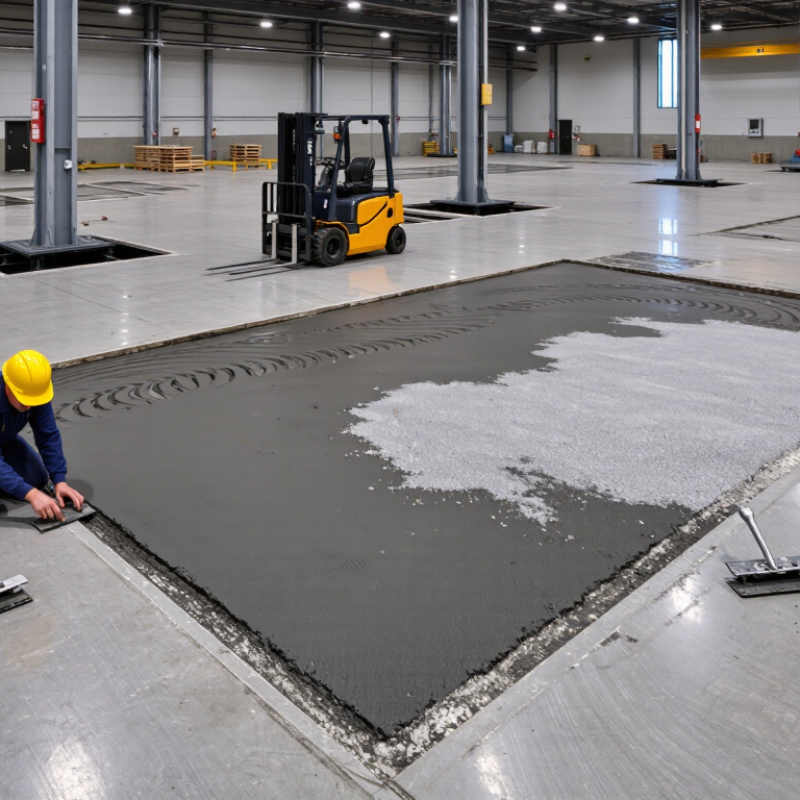
Industrial floor repair mortar is a formulated material used to restore damaged concrete in factories, warehouses, workshops, and loading areas. It fills localized spalls, chipped edges, shallow pits, and worn patches. Many mixes combine cement with graded aggregates and modifiers to improve bonding, strength, or setting time. The exact formulation matters. A repair must suit the damage depth, traffic, moisture, and expected return-to-service time. ASTM C928/C928M provides specifications for rapid-hardening cementitious materials used in concrete repairs. It gives engineers and contractors a basis for assessing repair material performance.
Its purpose is more than making a floor look smooth. A sound patch helps restore a level, serviceable surface for carts, forklifts, and foot traffic. The repair process usually includes removing loose concrete, preparing the exposed surface, placing mortar at the specified depth, and allowing it to cure. A patch can still fail if the original cause, such as repeated impact or moisture, remains. That part is easy to miss. The U.S. Bureau of Labor Statistics reported 865 fatal work injuries involving falls, slips, and trips in 2022. That figure does not mean floor defects caused each incident, but it shows why maintaining walking surfaces deserves attention. Industry guidance such as ACI 546R-14 also emphasizes diagnosis and substrate preparation, not just the choice of repair mix.
Industrial floor repair mortar is a cement-based blend designed to restore worn, chipped, or spalled concrete. Portland cement binds the mix; graded silica sand or quartz provides a dense, load-bearing skeleton. Polymer modifiers can improve adhesion, while fibers may help control crack formation. Water-reducing and setting admixtures adjust flow and working time. Exact formulations vary, so check the technical data sheet rather than assuming all repair mortars behave alike.
Performance depends on more than compressive strength. ASTM C928/C928M evaluates rapid-hardening repair materials for properties including strength, length change, and freeze-thaw resistance. ASTM C109/C109M measures mortar compressive strength using 50 mm cube specimens. These tests help compare products, but a laboratory result does not guarantee performance on a dusty, damp, or poorly prepared slab.
ICRI 310.2R guidance stresses selecting and preparing the concrete surface profile for the repair material. Small details matter. A thin repair edge, forklift traffic, and washdown water can expose weaknesses quickly. This part is easy to underestimate.
Tips: Remove weak concrete and dust before placement. Follow the specified mixing-water ratio; extra water may make the mortar easier to spread, but can compromise its properties. Drying and curing conditions still deserve careful attention.
Industrial floor repair mortar is selected by damage depth, exposure, and the time available before traffic returns. Polymer-modified cementitious mortar suits shallow spalls and worn areas where a mineral-based repair is practical. Rapid-setting cementitious mortar can reopen areas sooner, but rushed mixing or poor curing may weaken the patch. Epoxy mortar is often used for deeper, heavy-load repairs on clean, sound concrete; it is less forgiving when the substrate is damp or contaminated. Resin systems vary, so follow their technical data sheets.
The surface matters as much as the mix. ICRI Guideline 310.2R defines ten concrete surface-profile grades, CSP 1 through CSP 10, giving contractors a shared scale for specifying preparation. A thin repair may need a different profile from a deep patch exposed to forklift wheels. Check for hollow-sounding concrete, oil, standing water, and moving cracks before placing mortar. Conditions matter. A damp slab can disrupt bonding, while a rigid patch may crack beside an active joint. ACI 546R’s concrete-repair guidance also emphasizes diagnosing the cause before choosing materials. In practice, that step is easy to rush. Repair depth, temperature, and return-to-service time should guide the final choice.
| Mortar Type | Typical Composition | Common Repair Uses | Suitable Conditions | Important Considerations |
|---|---|---|---|---|
| Polymer-modified cementitious mortar | Cement, graded aggregates, and polymer modifiers. | Patching spalls, worn areas, and shallow-to-medium-depth defects in concrete floors. | General-purpose repairs where a compatible cement-based material is needed; often suitable for prepared concrete in interior or exterior settings, depending on the formulation. | Requires sound, clean concrete and correct mixing and curing. Follow the specified moisture condition and application thickness for the selected product. |
| Rapid-setting cementitious mortar | Fast-hardening cementitious binders with graded aggregates and performance additives. | Repairs to cracks, joints, edges, and localized surface damage when downtime needs to be limited. | Time-sensitive maintenance in operational areas, provided the repair can be prepared and placed within the material’s working time. | Working and setting times vary with temperature and product formulation. Confirm the required cure time before reopening to traffic or equipment. |
| Epoxy mortar | Epoxy resin and hardener combined with graded mineral aggregate. | Heavy-duty patches, damaged joints, and repairs requiring strong adhesion and resistance to many chemicals. | Prepared concrete in areas exposed to mechanical wear or chemical spills, when the specific resin system is compatible with the exposure. | Many epoxy systems require a dry substrate and controlled application conditions. Check chemical compatibility, temperature limits, and vapor-transmission requirements. |
| Polyurethane-cement mortar | Polyurethane resin, cementitious components, and mineral aggregates. | Repairs and resurfacing in food-processing, washdown, and other demanding wet-process areas. | Floors subject to frequent cleaning, moisture, thermal changes, or chemical exposure, where the chosen system is rated for those conditions. | Moisture tolerance and temperature resistance depend on the formulation. Surface preparation, installation thickness, and cure requirements are system-specific. |
| Magnesium phosphate repair mortar | Magnesium phosphate binder with mineral aggregates and related additives. | Fast-turnaround patching of concrete where early strength development is important. | Localized repairs that need to return to service sooner than conventional cement-based repairs, subject to product and site conditions. | Rapid reaction can leave limited placement time. Check substrate preparation, temperature limits, compatibility, and the specified reopening criteria. |
| Flowable cementitious repair mortar | Cementitious binder and carefully graded aggregates formulated for flow or pump placement. | Larger, contained repair areas, deep patches, or sections where placement around reinforcement or into prepared forms is needed. | Repairs with suitable formwork or boundaries and enough space for the material to flow and consolidate as designed. | Not intended for every thin or uncontained patch. Confirm flow characteristics, minimum and maximum placement depth, and curing method. |
Selection note: Choose repair mortar based on defect depth, traffic, chemical and moisture exposure, substrate condition, and required return-to-service time. Always follow the product technical data sheet and site-specific preparation and curing requirements.
What Is Industrial Floor Repair Mortar?
Typical Industrial Applications
Industrial floor repair mortar restores damaged concrete in production bays, warehouse aisles, loading docks, and maintenance areas. These surfaces face repeated forklift turns, pallet impacts, vibration, and dragged equipment. A suitable repair material can rebuild chipped joints or shallow spalls and return areas to service after curing. Some formulations are designed for fast return to traffic; others prioritize chemical or abrasion resistance. The right choice depends on the damage, substrate condition, exposure, and required reopening time.
In food and beverage plants, washdown rooms need repairs that tolerate frequent cleaning and moisture. Cold-storage floors present another challenge: temperature changes can stress poorly bonded patches. Around machinery, rigid, well-prepared repairs help limit edge breakdown under repeated vibration. Small detail, big difference. The U.S. Bureau of Labor Statistics recorded 865 fatal workplace injuries involving falls, slips, and trips in 2022. Its 2023 survey also counted about 2.6 million nonfatal workplace injuries and illnesses in private industry. These figures are not specific to floor failures, but they underline why damaged walking surfaces deserve prompt assessment. Mortar alone is not a cure. If movement, moisture, or contamination remains, the patch may fail again; that possibility is easy to underestimate.
Repair mortar is used to restore damaged concrete floors in industrial settings. The chart shows common repair tasks and illustrative repair-depth ranges.
Depths are general examples, not product specifications. Actual limits depend on the mortar, substrate condition, and installation requirements; follow the product data sheet.
Industrial floor repair mortar restores damaged concrete, but its performance depends heavily on preparation. Remove loose fragments, oil, dust, and weak coatings with suitable mechanical tools. The repair edges should be firm, not crumbling. Vacuum the area, then check for cracks or hollow-sounding sections nearby. Those details matter. A clean-looking surface can still hold fine dust, which may weaken the bond.
Check the product instructions for moisture limits, primer requirements, and mixing ratios. Use clean water and a measured container; guessing can change the mortar’s strength and working time. Add powder gradually while mixing at a low, steady speed. Scrape the bucket sides so dry pockets do not remain. Small batches help. They also reduce waste, though very small batches may be harder to mix evenly. That trade-off deserves attention on site.
Place the mortar within its stated working time, pressing it firmly into the prepared repair. A steel trowel can level shallow patches, while deeper repairs may need placement in layers if the instructions allow it. Keep edges neat and match the surrounding floor height to avoid creating a trip point. Protect the patch from traffic, rapid drying, and water during curing. Temperature and airflow can change curing conditions, so check the guidance rather than relying on a fixed schedule. A rushed repair may look finished before it is ready.